Compare shared and lineage-specific regulatory responses.
Research overview
Quest 01 / Individual and species levels
Molecular mechanisms of collective behavioral plasticity
How can the same genotype express radically different behaviors within hours?
Locust phase change connects sensory cues and individual variation to regulatory networks, collective behavior, and the evolutionary origins of plasticity.
INTERFACE / ACTIVEEVIDENCE / ONGOING
RESEARCH BACKGROUND
Why this system?
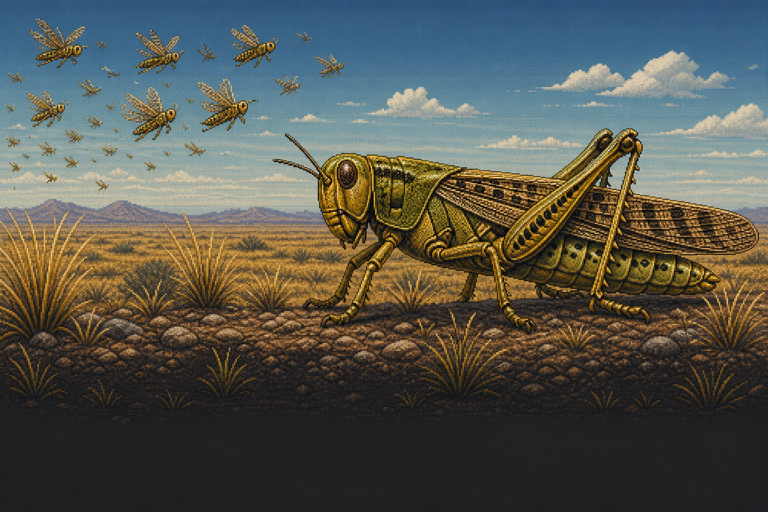
Locust phase polyphenism is an extreme example of behavioral plasticity: sensory and social cues can reorganize behavior, physiology, and appearance without changing the underlying genome. This system allows molecular responses to be followed across tightly sampled transitions.
QUEST DOSSIER / TRACEABLE EVIDENCE
Contribution and methods
Comparative locust genomic and transcriptomic research; exact project-role wording is [NEEDS MAÉVA REVIEW].
- Time-course RNA sequencing
- Comparative genomics
- Behavioral phenotyping
- Reproducible bioinformatics
QUESTIONS / SYSTEMS / APPROACH
From biological observation to evolutionary mechanism.
Guiding questions
- 01
Which early regulatory events accompany a change in behavioral state?
- 02
Why do individuals and species differ in their sensitivity to the same cues?
- 03
How does short-term plasticity relate to longer-term evolutionary potential?
Biological systems
- Locust species spanning a continuum of phase plasticity
- Fine-scale transitions from solitary to collective behavior
- Field populations and controlled laboratory experiments
Approaches
- Time-course transcriptomics and regulatory genomics
- Comparative multi-omics across taxa and tissues
- Behavioral phenotyping linked to individual molecular responses
- Reproducible workflow-based analysis
NEXT QUESTIONS
Research directions
Connect individual variation to the emergence of collective behavior.
Test how plastic responses differ across evolutionary histories.
COLLABORATION SIGNAL
Interested in this question?
I welcome collaborations connecting field biology, comparative genomics, and reproducible analysis.
Start a conversation